

Philosophy Colloquium
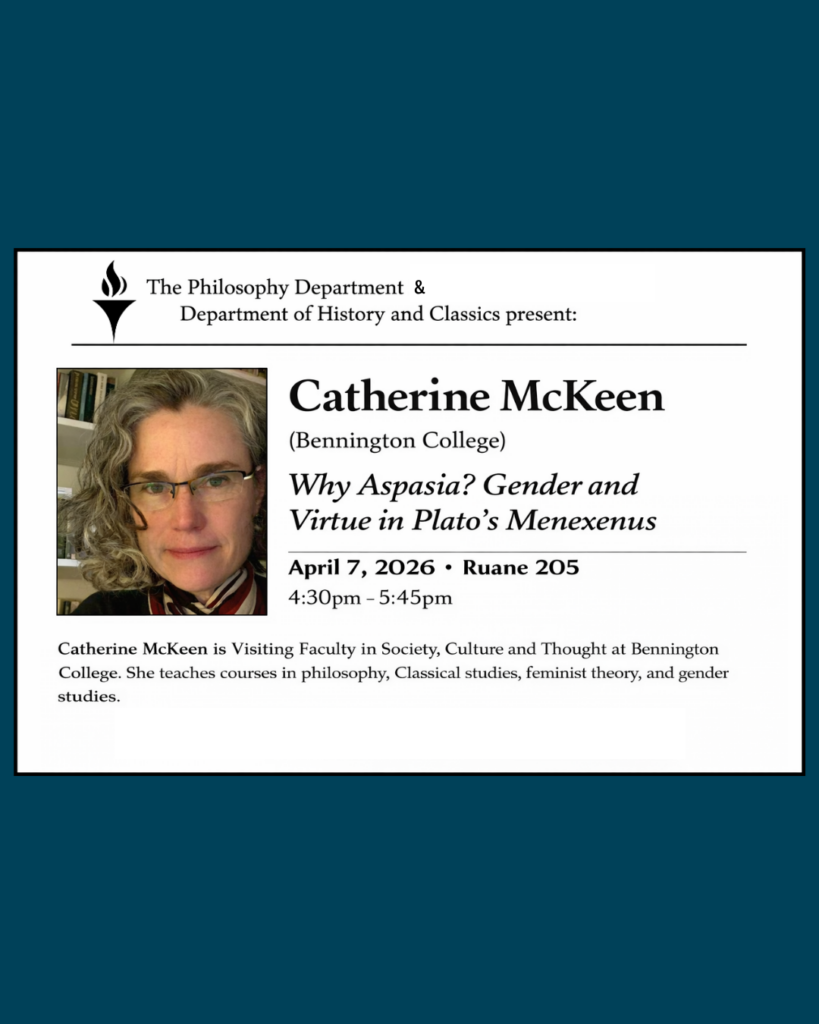
Abstract: In this paper, I argue that the figure of Aspasia in Plato’s Menexenus signifies a serious concern with gendered virtue and the proper social-political role for women. Rather than as a comic trope, ironical device, or mere conduit to Pericles, Aspasia signifies a striking rejoinder to the view of women’s virtue and proper role that is encapsulated in the Periclean Funeral Oration (Thuc. Histories II.xlv.2), which advises women to be “least talked about by men whether with praise or blame.”
Bio. Catherine McKeen is a philosopher whose work centers on Plato’s political thought and the presence of women and gender in Greek ancient philosophy. She co-edited, with Sara Brill, the Routledge Handbook of Women and Ancient Greek Philosophy (2024), a collection of 40 articles on women and gender in sources from Greek antiquity (7th c. to 2nd c. BCE), and in receptions of Greek antiquity from the Roman Imperial period to the current day. McKeen has published articles on Plato’s political philosophy, including on women in Plato’s Republic, the status of law in Plato’s Statesman, and on political faction (with Nick Smith). She is currently working on studies of gender and friendship in Xenophon’s Memorabilia and of Aspasia’s significance in Plato’s Menexenus.
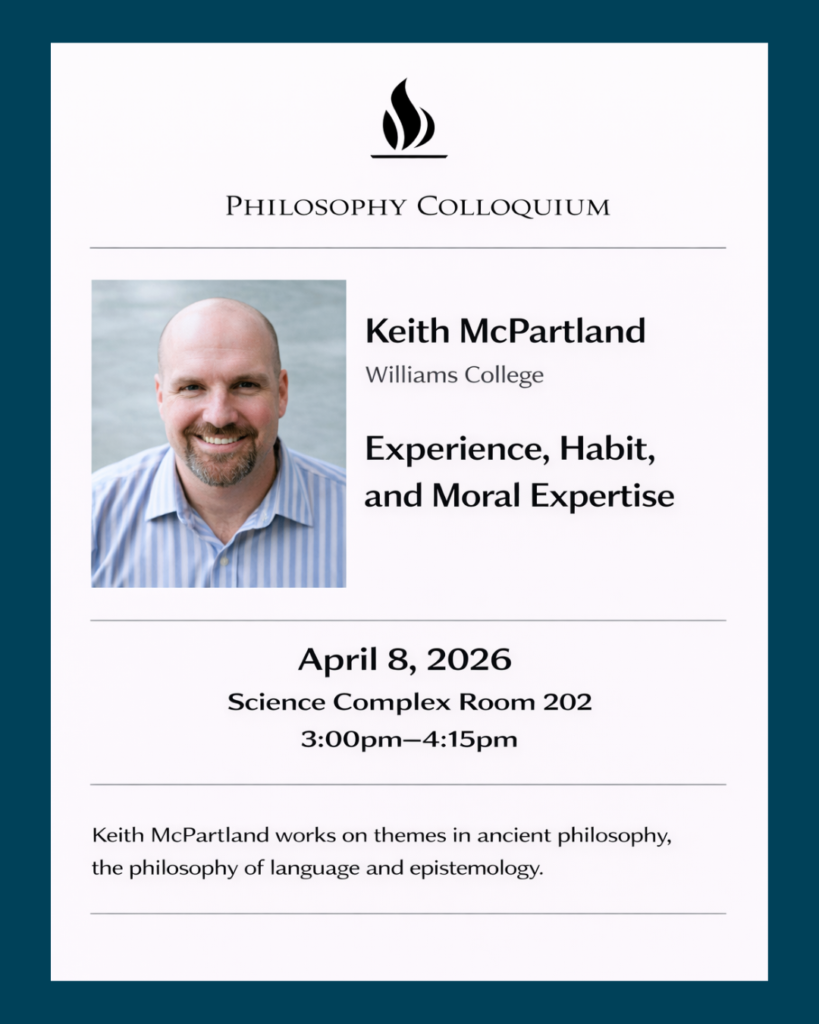
Abstract. Aristotle claims that experience (empeiria) is a necessary stage in the development of expertise. Empeiria involves a distinctive kind of mental content, one that functions as a bridge between perceptual and fully conceptual content. Empirical content plays a key role in allowing humans (and some non-human animals) to track general or universal facts about the world even in the absence of explicitly universal concepts. Aristotle’s account of the development of universal concepts can seem overly individualistic. A single human being, after many cases of perception and memory, comes to develop a single empeiria and then to grasp a universal. While I don’t deny that Aristotle takes this individualistic process to be possible, I do doubt that he takes it to be typical. Rather, the individual child is guided in forming her concepts by people who already have those concepts. In addition, her community’s successful tracking of important universal features of the world explains the child’s development of successful tracking abilities.
This reliance on a community is especially evident in the case of moral knowledge, as the polis exists for the sake of the virtue of the citizens. In this paper, I apply the general picture of empeiria sketched above to the development of moral expertise. I argue that Aristotle takes habituation to be a process by which we come to track objective moral facts about the world. Furthermore, I argue that this tracking essentially involves our affective and motivational capacities. Becoming habituated is coming to find the right sorts of things pleasant and painful, admirable and shameful, noble and base. It is, at least typically, through these thickly affective reactions that we register morally important facts about the world. Empirical tracking of morally relevant facts and the proper honing of our affective capacities go hand in hand in the development of moral knowledge.